Instant AI Agency Review (2026): A $14 Book Promises $1,000+ a Week From a "2-Line SMS" — What the Sales Page Leaves Out
Instant AI Agency sells a real business model — texting a company's old leads back to life — for less than a pizza. We read every line of the sales page, worked the numbers it never shows, and checked the one rule that can turn a $14 book into a $500-per-message problem.
Affiliate disclosure: some links on this page earn us a commission if you buy, at no extra cost to you. It never changes our verdict. How we make money.
A cheap, honest-enough introduction to a real service business — not the passive "$1,000+ a week" the headline sells, and silent on texting consent.
Worth a look if you
- Already talk to local business owners, or are happy to
- Want reactivation offers, scripts and deal structures in one place
- Will check consent rules before sending a single message
Skip it if you
- Want income that doesn't involve selling to businesses
- Planned to text people who never agreed to hear from you
- Need money this week
| Instant AI Agency at a glance | |
|---|---|
| Price | $14.40 (shown as reduced from $47), one-time; no upsells mentioned on the page |
| What you get | 167-page digital book + 6 bonuses (launch challenge, AI reply-bot template, A2P training, deal structures, website template, 42 niches) |
| Seller | Flexxable LTD, England & Wales, company no. 10976017 · retailer: ClickBank |
| Model | Database reactivation: text a business's old leads, let AI handle replies, take a fee or revenue share |
| Guarantee | 30 days, money back, keep the book |
| Biggest gaps | No sample messages, no named author, no tool or running costs, and no mention of texting consent (TCPA) |
If you have spent any time around "AI agency" content this year, you have seen the pitch. Somewhere a beginner is "quietly" earning four figures a week. The method is simple. The book costs less than lunch.
This one is called Instant AI Agency. Its headline reads: "Copy This '2-Line SMS' AI System That's Quietly Paying Complete Beginners $1,000+ Per Week." The subheadline promises a system that "restarts conversations and turns forgotten leads into sales, appointments, and new revenue."
I wanted to know two things. First, is the business model behind it real? Second, does the sales page give a beginner what they need to know before they start?
So I read the official Instant AI Agency page line by line on October 24, 2026. I listed every claim and every number. Then I went looking for what people who actually run this kind of campaign say about it — the practitioners on Reddit who post their delivery problems, their pricing questions and their legal worries, not their highlight reels. Finally I did the arithmetic the page doesn't do.
One thing up front, because it matters: I did not buy the book for this version. Everything below comes from the public sales page, its guarantee terms, public discussions by people doing this work, and the rules that govern business texting. I won't pretend to review chapters I haven't read. Where the page is silent, I say so.
1. The 60-second verdict
If you only read one section, read this one.
- What it is: a 167-page downloadable book plus six bonuses, sold through ClickBank by Flexxable LTD, a company registered in England & Wales (number 10976017). Price on the page: $14.40, shown as reduced from $47.
- What it teaches: "database reactivation" — contacting a business's old, quiet leads by text message, using AI to handle replies, and taking a share of the sales that result. The page mentions a 30–50% share in some places and "half" in others.
- Is the model real? Yes. Reactivating old leads is one of the most-discussed small-business automations of 2026, and it works for some businesses. It is not a secret and it is not new.
- What the page doesn't show: a single sample of the famous "2-line SMS," the name of the person behind the method, which software you need, or what it costs to run.
- The biggest gap: the page mentions only one rule — A2P registration for business texting in the U.S. It never mentions consent. In the U.S., marketing texts sent without the right consent can expose the sender to statutory damages of $500 to $1,500 per message under the TCPA. That single omission is the most important thing in this review.
- The income claims: "$1,000+ per week" for complete beginners, a case study of "Rob" hitting "£20k/mo" in six weeks, "40–60% reply rates," "60–80%" close rates. The page itself says these "results are not typical."
- The guarantee: 30 days, money back, request by message or email, and you keep the book. For $14.40, that makes the purchase itself low-risk.
Is it a scam? No. It sells a real model at a low price with a refund promise. Is it a reliable path to $1,000 a week for a complete beginner? Nothing on the page shows that, and the math below explains why the "per week" part is the hardest bit to believe.
2. What you actually get for $14.40
Here is everything the sales page lists, as of October 24, 2026.
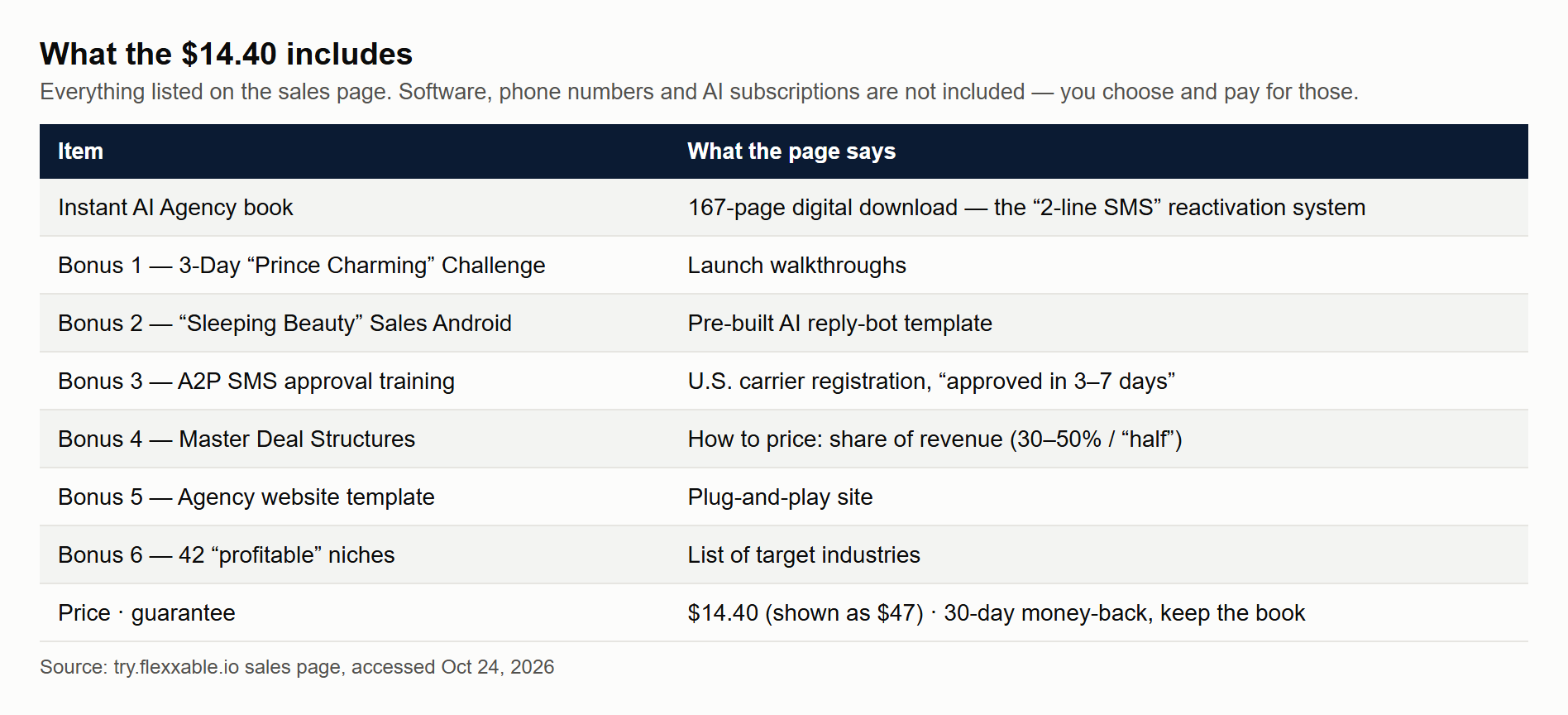
A few details are worth knowing before you go further:
- It's a book, not software. You get a 167-page digital book and templates. You do not get a texting platform, phone numbers, an AI subscription or a CRM. You will need to choose and pay for those yourself.
- No upsells are mentioned on the page. The six bonuses are presented as included. That's genuinely better than many products in this category, which hide a $297 "pro" upgrade behind the checkout. (I can't confirm what appears after purchase, because I didn't complete one.)
- The retailer is ClickBank. Your card statement will show ClickBank, and ClickBank's footer notes that its role as retailer "does not constitute an endorsement" of the product or its claims.
- The creator is a company, not a person. The page credits the method to "10 years in the lead generation trenches and 18 months obsessively testing AI and SMS," but never names who that is. The only legal entity on the page is Flexxable LTD.
- The price currency wobbles. The price is in dollars; the case studies are in pounds. Small thing, but it tells you the page was assembled from more than one source.
None of that is a red flag on its own. Plenty of honest info products are sold by small companies through ClickBank. It just means the book is the beginning of your costs, not the end.
3. The business model, in plain English
Strip away the "2-line SMS" branding and the idea is old and sensible.
Every service business has a pile of people who once asked for a quote and never booked: the homeowner who wanted a new roof last spring, the patient overdue for a cleaning, the gym member who froze their membership, the customer who bought once and vanished. Most businesses follow up two or three times and then stop. That pile — "the database" — is money that has already cost something to acquire.
Database reactivation means going back to that pile with a short, friendly message, usually by text because texts get read. When someone replies, an AI assistant (or a person) answers questions and books a call or appointment. The business pays you either a fee or a share of what those booked conversations turn into.
Done properly, this is a real service. Practitioners on Reddit describe running it for HVAC and roofing contractors, dental practices, gyms and online education platforms. One founder who built an outbound reactivation system for an online course platform described the hard part honestly: "Most voice AI content stops at the demo. The hard part starts after that."
That sentence is the whole story of this market. The idea is easy. Delivery is the job.
4. The claims, checked against the page itself
I listed every number on the sales page and asked one question of each: does the page show anything that supports it?
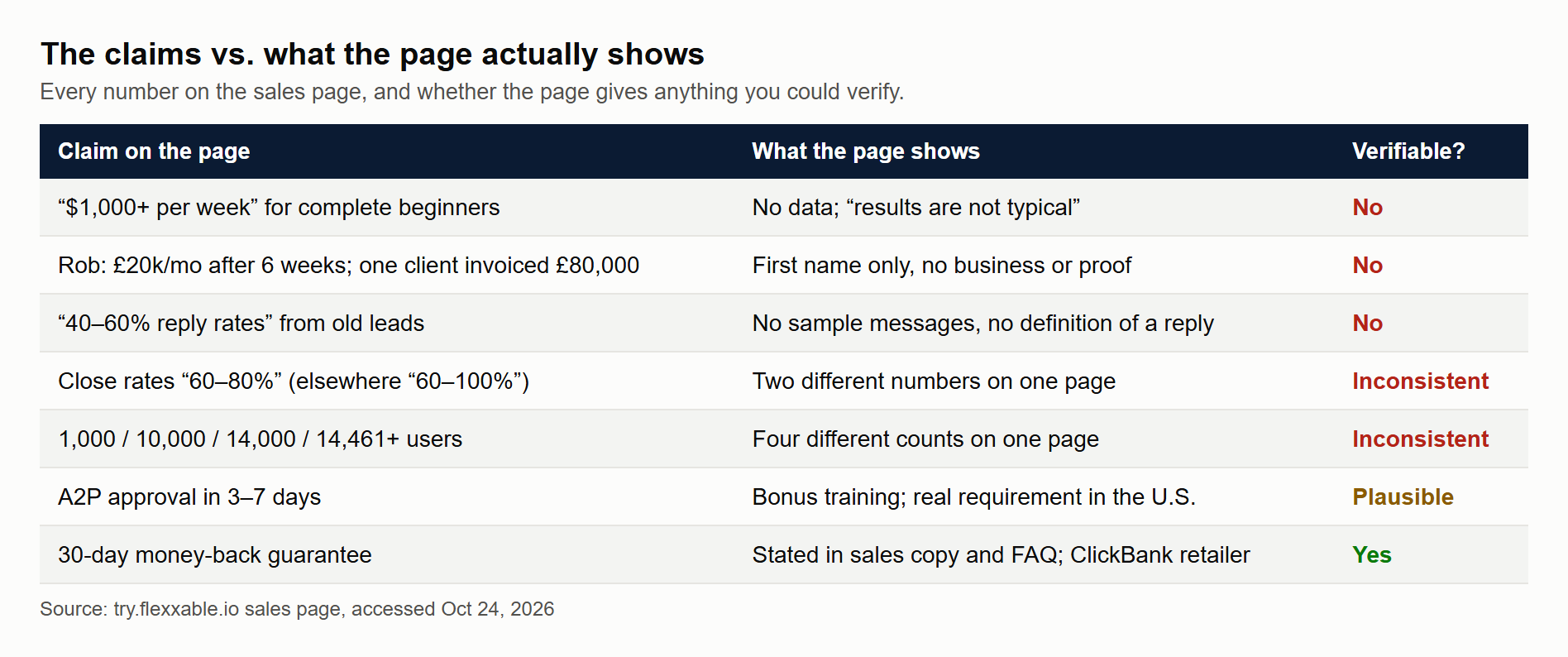
Three observations.
The page contradicts itself on its own numbers. The count of people using the system appears as "1,000 agency owners," "over 10,000," "over 14,000" and "14,461+" on the same page. The close rate appears as "60–80%" in one place and "60–100%" in another. The revenue share is "30–50%" and "half." None of these is a crime, but if a page can't keep its own numbers consistent, I don't treat its other numbers as measurements.
There is exactly one named case study, and it's a first name. "Rob" quit his 9-to-5, hit "£20k/mo" six weeks later, invoiced "ONE client £80,000," and is "on track to do 8-figures in his FIRST year." There is no surname, business name, link or screenshot I could verify, and the page labels results like these "not typical."
"40–60% reply rates" deserves the most caution. Replies to a friendly text from a business you once contacted can be high — texts are opened far more than emails — but a reply is not a sale. "Stop," "wrong number" and "who is this?" are replies too. A reply rate tells you almost nothing until you know how many replies became booked appointments, and how many of those became paid jobs.
5. The math the page doesn't do
Here is the part I most wanted to see on the sales page and didn't.
Your income from reactivation is the product of a chain of percentages. If any link is weak, the result collapses. Let's write the chain down with illustrative numbers. These are not measurements; they are assumptions you can replace with your own.
- A client gives you 1,000 old leads.
- R% of them reply.
- 30% of replies book an appointment.
- 30% of appointments turn into a sale.
- The average sale is $500.
- You keep 30% of revenue.
Each old lead is then worth: R × 0.30 × 0.30 × $500 × 0.30 = R × $13.50.
At a 10% reply rate, each lead is worth $1.35 to you. To earn $1,000, you need about 741 leads — most of a typical small business's list. At the page's 50% reply rate, you need about 148.
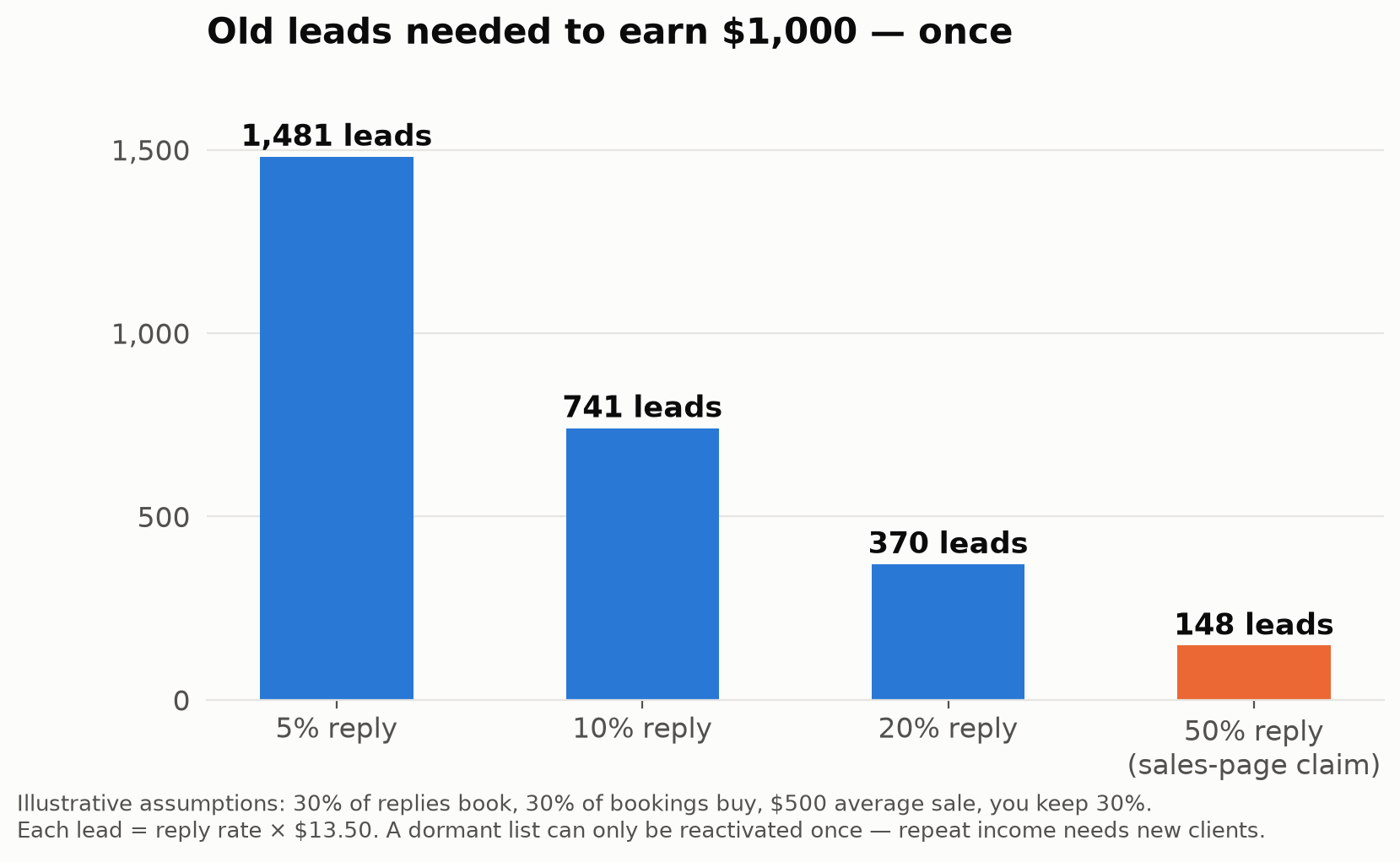
Now the part that matters most, and the reason I'm skeptical of the words "per week":
A dormant list can only be reactivated once. After you've texted those 1,000 people, the ones who were going to come back have come back. Texting the rest again next week gets you complaints and carrier filtering, not more sales. To earn $1,000 every week, you don't need one good campaign — you need a new client with a new list every week or two, plus the time to set up, run and report on each one.
That's not impossible. Agencies do exactly this. But it's a sales job — finding, pitching and onboarding business owners — with an automation attached, not an automation that pays you while you sleep.
If you'd like to see how the book proposes to find those clients, the Instant AI Agency page is here. Read its outreach and "15-minute Zoom" sections with the chain above in mind, and ask how each link is supposed to hold.
6. The rule the sales page never mentions: consent
This is the section I'd most want a beginner to read.
The sales page says, correctly, that "in 2026, there's no such thing as sales without compliance." The only compliance item it names is A2P approval — the U.S. carrier registration (often called A2P 10DLC) that businesses need before sending texts from ordinary local numbers. The page says the bonus training gets you approved in "3–7 days."
A2P registration is necessary. It is not sufficient. It tells carriers who is sending. It does not give you permission to text anyone.
Permission is a separate question, and the page never raises it.
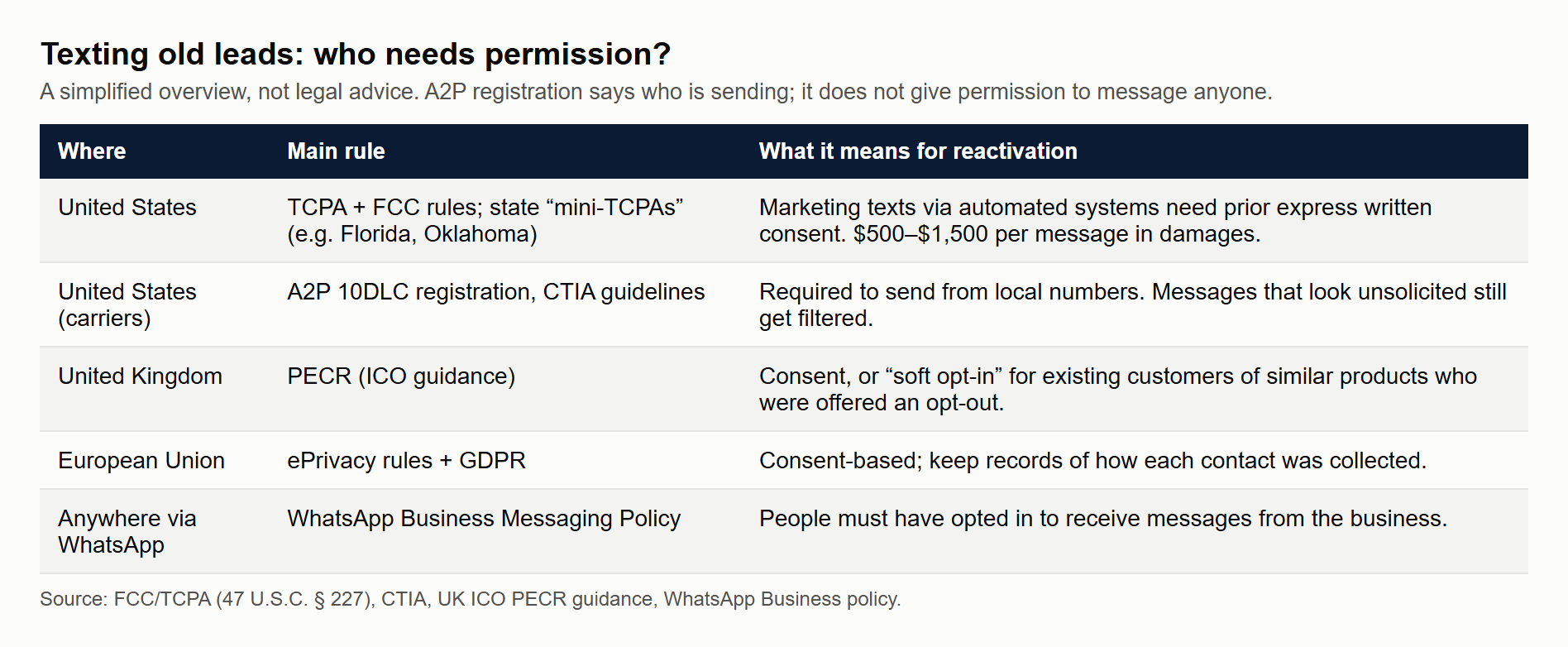
In the United States, the Telephone Consumer Protection Act (TCPA) and its rules require prior express written consent for marketing texts sent with automated systems. Statutory damages run $500 per message, up to $1,500 if the violation is willful, and TCPA class actions are a cottage industry. Several states, including Florida and Oklahoma, have their own "mini-TCPA" laws with similar penalties. Ten messages to the wrong people is a rounding error; ten thousand is a lawsuit.
Practitioners are asking exactly this question. A thread in r/agency this June put it bluntly: "Isn't database reactivation against TCPA since almost nobody's customer list opted in?" That's the right instinct. A list of people who once filled in a quote form may or may not include valid marketing consent, depending on what the form said. A list of people who once phoned the office almost certainly doesn't.
There's also a practical problem on top of the legal one. In September, a user in r/HighLevel described sending just 50 SMS to a client's past customers — with A2P verification and number validation in place — and still getting flagged twice. Carriers filter messages that look like unsolicited marketing, whether or not you're registered.
In the United Kingdom, marketing texts generally need consent under PECR, with a narrow "soft opt-in" for existing customers who bought similar products and were offered an opt-out at the time. In the EU, the ePrivacy rules and GDPR apply. If you're outside these markets and planning to use WhatsApp, its business policy requires that people have opted in to receive messages from the business.
None of this means database reactivation is illegal. It means the client's list has to be clean, and you have to check before you send. A $14.40 book that promises income from texting old leads and never uses the word "consent" leaves its buyers to find this out the expensive way.
What I'd do before any campaign:
- Ask the client how each contact was collected and what they agreed to. Keep a copy of the form wording.
- Text only people who are existing customers or opted in, and include a clear way to stop ("Reply STOP to opt out").
- Put consent responsibility in writing in your agreement with the client.
- If the client is in the U.S. and the list is large, spend an hour with a lawyer. It is cheaper than one bad week.
7. What a safer "2-line SMS" looks like
The sales page never shows its famous two lines, so I can't review them. What I can do is show you what a reactivation message needs to contain to be both effective and defensible. Every version below does three things the law and the carriers care about: it says who is texting, it gives a reason the person would recognise, and it offers a way out.
For a home-services company (past quote requests who opted in to texts):
Hi Sarah, it's Mike from Brightline Heating. You asked us about a furnace quote last winter — still something you're thinking about? Reply STOP to opt out.
For a dental practice (existing patients overdue for a check-up):
Hi James, Dr. Patel's office here. It's been about 14 months since your last cleaning — want us to find you a time this month? Reply STOP to opt out.
For a gym (former members who agreed to marketing messages when they joined):
Hi Lena, it's Coach Ana at FitHouse. We've added early-morning classes since you last trained with us — want a free week to try them? Reply STOP to opt out.
Notice what these messages don't do. They don't pretend to be a friend ("Hey! Long time!"), they don't invent urgency, and they don't hide the business name. Messages that do those things get more replies at first — and more spam reports, which is how numbers get filtered and how complaints turn into legal letters.
The AI part comes after the reply. When Sarah writes back "yes, but what does a new furnace cost?", an assistant trained on the client's price list and calendar can answer the basic questions and offer two appointment slots. That's where automation genuinely saves time. It's also where you need a human ready to step in, because a wrong price quoted by a bot is still the client's problem.
8. What it really costs to run
The book is $14.40. The business isn't. Here are the cost lines a beginner should budget for, with the honest caveat that prices change often and you should check each provider's current pricing page before you commit.
- Texting. U.S. business texting through providers like Twilio is charged per message segment, typically around a cent per message once carrier fees are added. Ten thousand messages is real money, not pocket change, and long messages split into multiple segments.
- A2P 10DLC registration. Registering the brand and the messaging campaign carries one-time vetting fees and a small monthly campaign fee. Approval is not guaranteed; vague campaign descriptions are a common reason for rejection.
- A CRM or texting platform. Many reactivation agencies use an all-in-one CRM such as GoHighLevel, a real monthly subscription before add-ons. You can build cheaper with separate tools, but you pay in setup time.
- AI replies. Using a large language model to draft replies costs little per conversation, but someone has to write the instructions, feed it the client's prices and policies, and check what it says.
- Your time. Cleaning a list, writing messages, getting approval, monitoring replies, booking calls and reporting results is several hours per client, every time.
None of this makes the model unprofitable. A single closed roofing job can pay for months of tools. But it explains why "complete beginners" earning "$1,000+ per week" is the hardest part of the headline to believe: before the first payout, you have costs, an approval process and a sales cycle.
9. A worked example: one client, start to finish
Let's put the pieces together with a realistic, illustrative example. The business is a heating-and-cooling company with 1,200 past quote requests collected through a website form that included a text-message consent box.
Week 1 — agreement and list. You agree on a $300 setup fee plus 10% of revenue from booked jobs for 60 days. You get the export and remove duplicates, landlines and anyone who has opted out before. 1,200 becomes 940 textable contacts. You keep a copy of the consent wording from the form.
Week 2 — approval and setup. The A2P campaign is submitted and approved after a few days. You write three message variants and the AI reply rules, and the owner signs off on the prices the bot may quote.
Week 3 — send in batches. You send 150 messages a day, not all 940 at once, so the owner's team can keep up and carriers see a normal pattern. 9% reply — 85 people. Twelve say stop, nine say wrong number, and 64 are real conversations.
Weeks 3–5 — bookings and sales. Twenty-one conversations book an estimate. The company closes seven jobs at an average of $3,400.
Your result: $300 setup + 10% of $23,800 = $2,680 for roughly five weeks of part-time work. The owner gets $23,800 of revenue from people who had already said no once.
That's a genuinely good outcome — and notice what made it work: a clean, consented list, an owner who answered the phone, a high-ticket service and a fee structure that paid for your time. Change any one of those (a $40 average sale, a list with no consent, an owner who doesn't follow up) and the same campaign earns a fraction of this.
It's also one client, once. The list is now reactivated. Next month's income depends on the next client.
10. What practitioners say (beyond the sales pages)
I spent time in the communities where people actually run these campaigns — r/gohighlevel, r/HighLevel, r/AI_Agents, r/agency and r/SideProject. Four patterns came up again and again.
1. It isn't secret. Under a popular r/AI_Agents post calling lead reactivation "the #1 AI automation that prints money," one of the first replies was: "Literally every video on youtube is about this." If a sales page calls this a hidden method, it's marketing.
2. It works best as a small, honest win. One commenter described looking at their own Square customer list, finding about 40 people who had bought once and never returned, and sending a simple "we miss you" email by hand: five came back. That's a 12.5% win with no automation at all — a useful reality check on what "reactivation" usually looks like.
3. People are still working out how to charge. A r/gohighlevel thread asked other agencies whether they charge a setup fee, a monthly retainer, a revenue share or pay-per-booking. There's no settled answer, which matters for you: revenue share sounds generous but means you only get paid when the client reports sales honestly.
4. Not everyone welcomes it. Under the same "prints money" post, another user called reactivation campaigns spam: "all I hear is: let's bother every professional that was not interested." Whatever you think of that, it's how some recipients feel — and recipients are who decide whether your number gets reported.
There's also a broader point that one maker in r/SideProject put well when launching a cheap course on the same topic: they kept seeing "$997 'AI agency' funnels that sell prompts and a Discord," while "the actual job is smaller: pick one local industry, find one repetitive leak, sell a working demo, get paid before you polish." Whether you buy this book or not, that's sound advice.
11. How to price it so you get paid
If you do go ahead, the pricing model matters more than the message template.
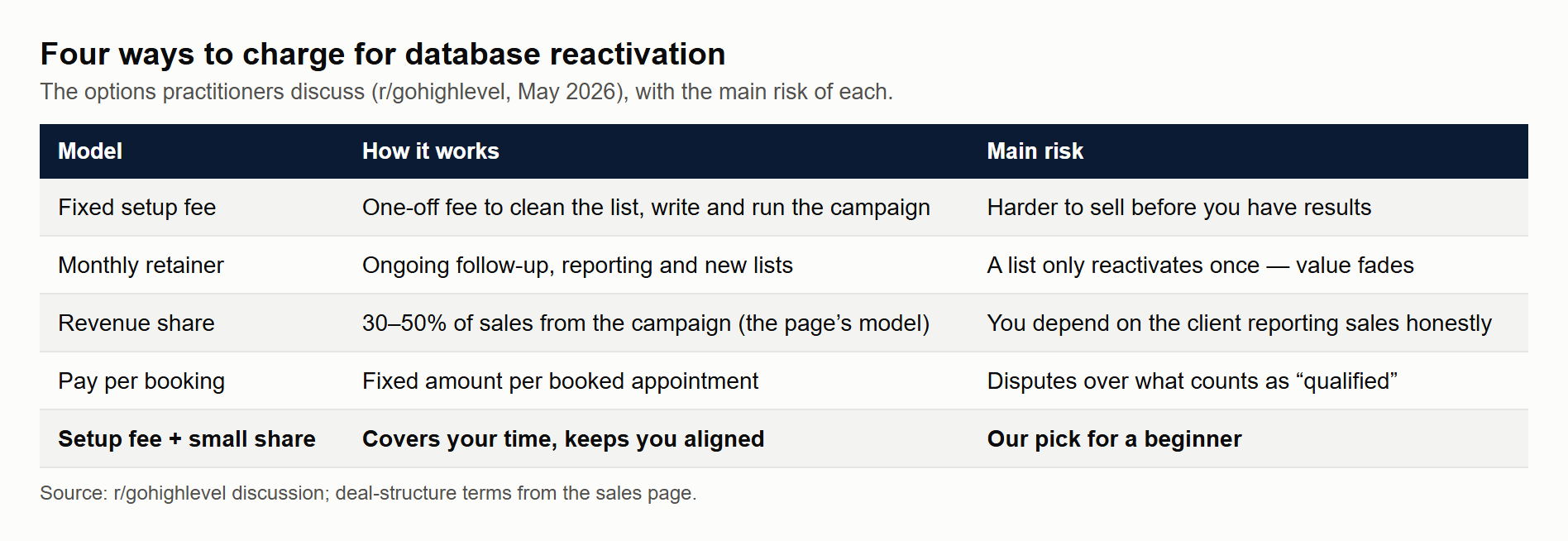
My own preference for a beginner: a small fixed setup fee plus a modest share or per-booking fee. The setup fee pays for your time even if the list is weak or the client doesn't follow up on the appointments. The variable part keeps you aligned with the client. Pure revenue share — the model the sales page leans on — puts all the risk on you and relies on the client telling you what they sold.
12. The guarantee — and how to actually use it
The page offers a "30-Day, 100% NO BS Money-Back Guarantee." The sales copy says to "message us"; the FAQ says to "email our support team." Either way, you keep the book and bonuses.
At $14.40, the main thing to protect is your time, not your money. If you buy:
- Put the refund deadline in your calendar today — 28 days from purchase, to leave a margin.
- Read the compliance and outreach sections first. If the book covers consent properly, that alone may be worth the price. If it doesn't, you now know what to look up.
- Decide on one niche and one test client before day 30. If you can't get a single business to give you their list, that's the honest answer about whether this model fits you right now.
- Keep the receipt email. ClickBank processes refunds for its products; the receipt has the order number they'll ask for.
13. Who might reasonably buy it — and who should skip it
It may be worth $14.40 if:
- you already talk to local business owners — or you're comfortable picking up the phone to them,
- you want a structured overview of reactivation offers, scripts and deal structures in one place,
- you will check consent rules for your market before sending anything,
- you treat it as a starting manual for a sales-and-service business, not as a passive income system.
Skip it — or at least don't expect the headline — if:
- you're looking for income that doesn't involve selling to businesses,
- you were planning to text lists of people who never agreed to hear from you,
- you need money this week; even in the best case, the first payment depends on finding a client, running a campaign and waiting for sales,
- you're outside the U.S. and the U.K. and your clients mostly use WhatsApp — the SMS mechanics and A2P training may not apply to you at all.
14. If you're outside the U.S.: WhatsApp and email
The book is built around SMS and U.S. carrier approval. If your clients are in Indonesia, India, Latin America, Africa or most of Europe, their customers probably live on WhatsApp, not text messages.
The model translates well, with two changes. First, use the WhatsApp Business Platform (through Meta directly or an approved provider) rather than blasting from a personal number; personal-number blasts are a fast way to get the number banned. Second, business-initiated WhatsApp messages need opt-in and approved message templates, and Meta charges per message by category and country. The friendly-reason-plus-opt-out structure above still applies.
Email is the low-cost fallback everywhere. Response rates are lower than text, but it's cheap, it handles longer messages, and in many markets the rules for emailing existing customers are clearer than for texting them.
15. A 14-day plan to find your first client (whether or not you buy the book)
- Day 1–2: pick one niche where one sale is worth at least a few hundred dollars and the business obviously has old leads — roofing, HVAC, dental, med-spa, driving schools.
- Day 3: write a one-page offer in plain words: "I'll message your past customers and quote requests who agreed to hear from you, book the ones still interested into your calendar, and charge $X setup plus Y% of booked work."
- Day 4–7: talk to ten owners. Start with people you or your friends already know. A warm introduction beats a hundred cold messages.
- Day 8: ask the consent question before anything else: "How did these contacts get on your list, and what did the form say?" If the answer is unclear, offer an email campaign instead.
- Day 9–12: run a small pilot — 100 to 200 contacts — and report every number, good and bad.
- Day 13–14: turn the pilot into a case study with the owner's permission. Your next sale is much easier with one real result than with any sales page.
That plan costs nothing but time. It also tells you, within two weeks, whether you enjoy the actual job.
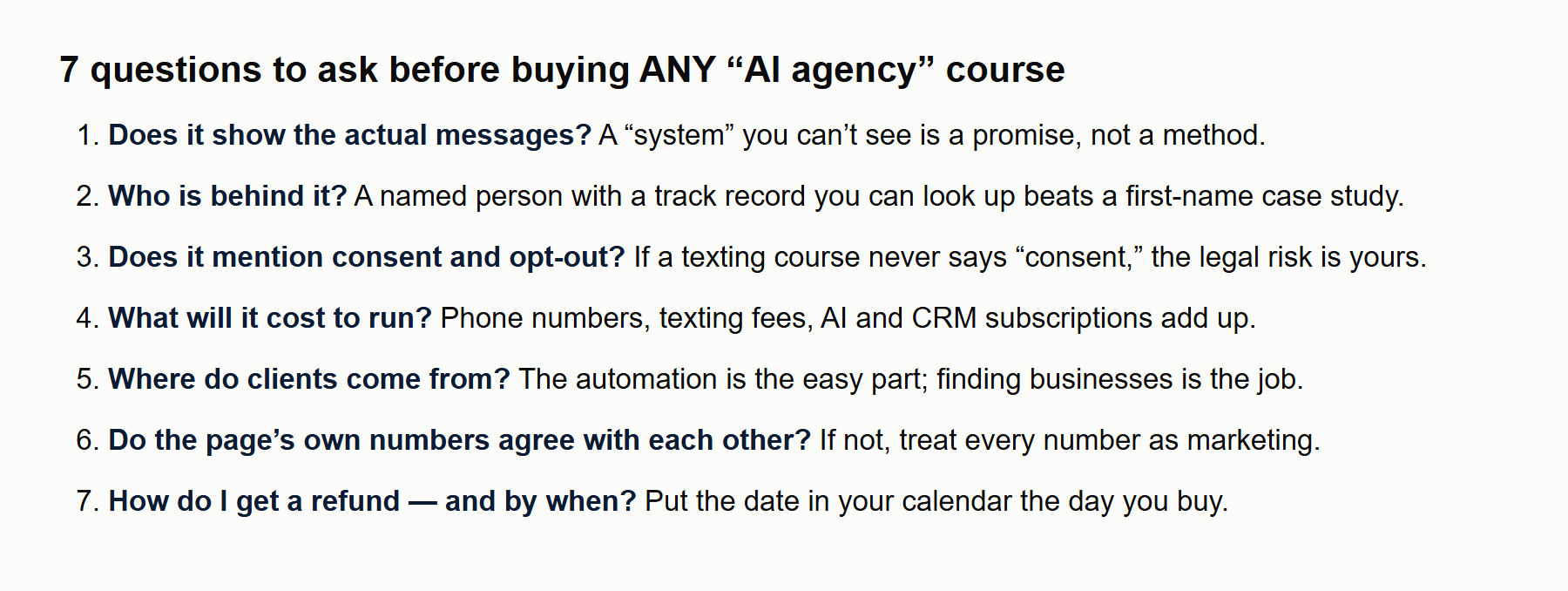
16. Before you start ANY "AI agency" offer: the checklist
17. The bottom line
Instant AI Agency is not a scam in the way a "push-button profit app" is a scam. It sells a real, widely practiced service model, at a low price, with a refund promise and no upsell mentioned on the page.
But the product being marketed — a "2-line SMS" that quietly pays complete beginners $1,000+ a week — is not what the model looks like from the inside. From the inside, it looks like a small agency: you find businesses, win their trust, get their list, check that you're allowed to message it, run the campaign, handle the replies and chase the reporting. The AI makes some of that faster. It doesn't make it disappear.
The sales page's biggest failure isn't the optimistic income numbers — almost every page in this category has those. It's that a product built on texting old leads never mentions consent, the one rule that can turn a $14 experiment into a five-figure liability in the U.S.
If you understand that, keep your expectations honest and use the 30-day guarantee wisely, $14.40 is a cheap way to see whether this business suits you. If you'd like to read the claims for yourself and decide, you can see the official Instant AI Agency page here. Look for the sample messages. Look for the word "consent." And if you buy, put that refund date in your calendar today.
18. Sources
- Instant AI Agency sales page (try.flexxable.io), accessed October 24, 2026 — headline, price ($14.40, from $47), 167-page book, six bonuses, 30-day guarantee, A2P training claim, case-study figures, user counts, Flexxable LTD registration number 10976017.
- Federal Communications Commission — Telephone Consumer Protection Act (47 U.S.C. § 227) and FCC rules on autodialed/prerecorded marketing calls and texts; statutory damages of $500 per violation, up to $1,500 if willful.
- CTIA Messaging Principles and Best Practices; The Campaign Registry — A2P 10DLC registration for U.S. business messaging.
- UK Information Commissioner's Office — Guide to the Privacy and Electronic Communications Regulations (PECR), electronic mail marketing and the "soft opt-in."
- WhatsApp Business Messaging Policy — opt-in requirement for business-initiated messages.
- Reddit, r/agency (June 2026): "Isn't 'database reactivation' against TCPA since almost nobody's customer list 'opted in'?"
- Reddit, r/HighLevel (September 2026): "Database reactivation issues" — 50 SMS flagged twice despite A2P verification.
- Reddit, r/gohighlevel (May 2026): "How are you packaging/reactivating old lead databases in GHL?"
- Reddit, r/AI_Agents (March 2026): "The #1 AI automation that prints money for small businesses…" and replies.
- Reddit, r/VoiceAutomationAI (July 2026): founder's post on shipping an outbound database-reactivation calling system.
- Reddit, r/SideProject (August 2026): "I made a 10 USD course on starting an AI agency."
Product details are from the sales page as accessed on October 24, 2026, and may have changed since. This article is not legal advice.
Frequently asked questions
Is Instant AI Agency a scam?
No. It is a $14.40 digital book plus six bonuses, sold through ClickBank by Flexxable LTD (registered in England & Wales, number 10976017), with a 30-day money-back guarantee. It teaches a real model — reactivating a business's old leads by text message. What the sales page does not support is its headline claim that complete beginners earn $1,000+ per week; the page itself says those results are not typical.
How much does Instant AI Agency cost?
The sales page shows $14.40, reduced from $47, as of Oct 24, 2026. No upsells are mentioned on the page. Running the business costs extra: texting fees, A2P 10DLC registration in the U.S., a CRM or texting platform, and AI usage.
What is the "2-line SMS"?
The sales page never shows it. It describes a short reactivation text that restarts conversations with old leads. A defensible version says who is texting, gives a reason the person will recognise, and offers an opt-out such as "Reply STOP to opt out." Examples are in this review.
Is texting old leads legal?
It depends on consent and location. In the U.S., marketing texts sent with automated systems generally require prior express written consent under the TCPA, with statutory damages of $500 to $1,500 per message. The UK, EU and WhatsApp have their own consent rules. A2P registration alone does not give permission to message anyone. This is not legal advice.
How much can you realistically earn?
It depends on the list, the reply rate, the business's average sale and your fee. With illustrative assumptions (30% of replies book, 30% buy, $500 average sale, 30% share), earning $1,000 once takes about 741 old leads at a 10% reply rate. A dormant list can only be reactivated once, so repeat income needs new clients.
Does it work outside the United States?
The model does, but the book's SMS and A2P training are U.S.-focused. In markets where customers use WhatsApp, use the WhatsApp Business Platform with opt-in and approved templates, or email as a lower-cost option.
How do I get a refund?
The page offers a 30-day money-back guarantee; the sales copy says to message them and the FAQ says to email support. ClickBank processes the order, so keep your receipt email with the order number, and request the refund before day 30.
Cheap to try, real model, unrealistic headline — and check consent before you send anything.
If you understand that this is a small agency business rather than passive income, $14.40 with a 30-day refund is a low-cost way to see whether the work suits you. Put the refund date in your calendar the day you buy.
What changed in this update: First published Oct 24, 2026 as a pre-purchase research review. Sales-page details checked Oct 24, 2026.
Get the next review in your inbox
One email a week: one offer checked, one number, one honest verdict.