How to use this calculator
- List every debt, including credit cards, store cards, personal and car loans, medical bills, buy-now-pay-later plans and student loans. A mortgage is usually left out.
- Copy three numbers from each latest statement: the balance, the APR (the purchase APR for cards) and the minimum payment due.
- Pick an extra amount you can pay every month on top of the minimums. Be realistic, because a plan you keep beats a bigger one you drop.
- Compare the two methods and choose one. Then pay the minimums on everything and put the extra on the target debt, every month.
Snowball vs avalanche, in plain numbers
Both methods use the same monthly budget: all your minimums plus your extra amount. The only difference is which debt gets the extra.
- Avalanche: the extra goes to the highest APR first. Mathematically, nothing beats it on total interest.
- Snowball: the extra goes to the smallest balance first. You close accounts sooner, which keeps many people motivated.
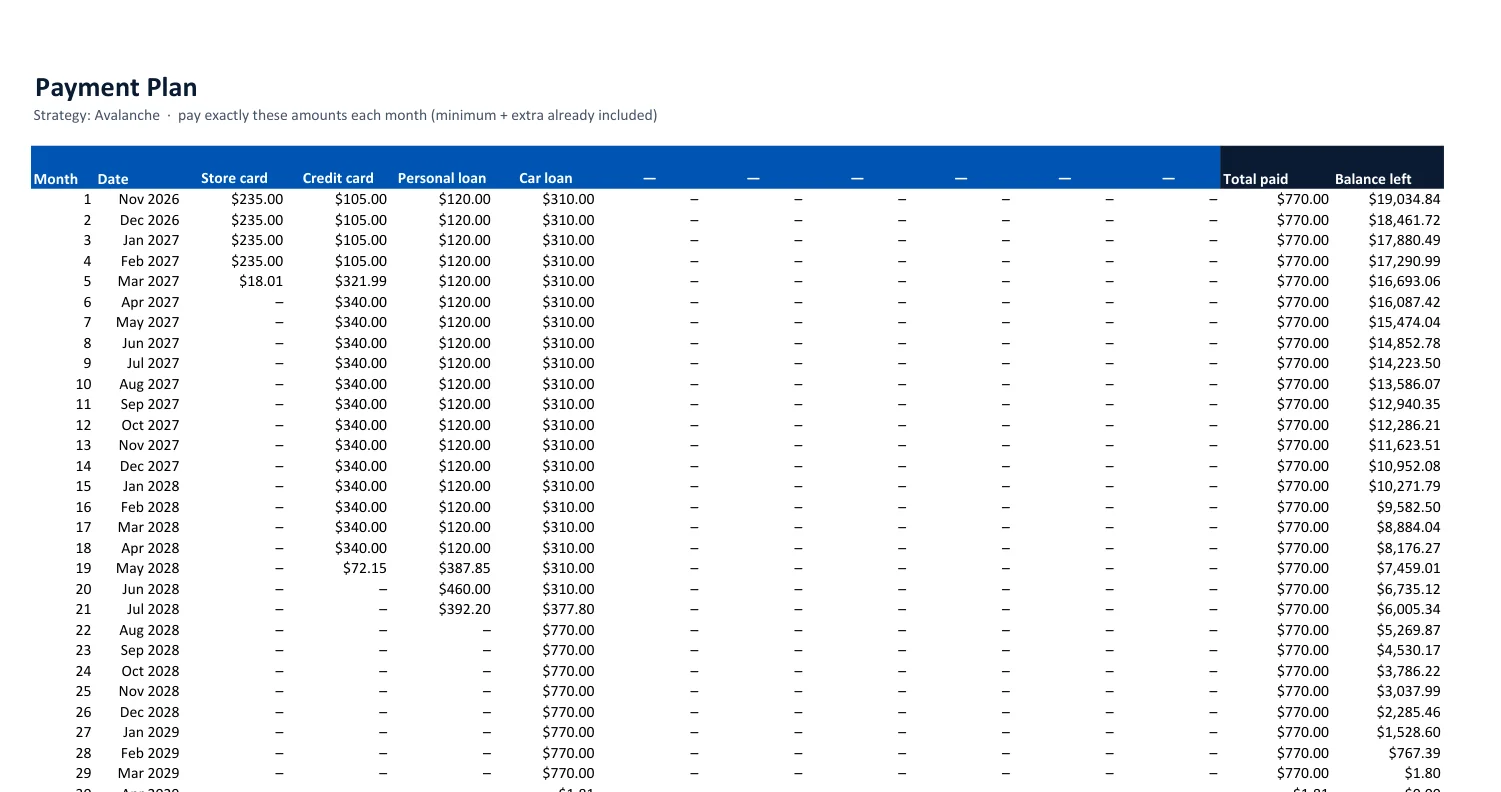
Take the example built into this calculator: a $900 store card at 29.99%, a $4,200 credit card at 24.99%, a $3,000 personal loan at 11.5% and an $11,500 car loan at 6.9%, paying $770 a month. Both methods finish in 30 months. Avalanche costs $2,731.81 in interest and snowball costs $2,988.74, so the difference is $256.93. Snowball pays off its second debt in month 12, while avalanche gets there in month 19. With the minimums only and no rollover, the same debts would take 87 months and cost $7,394.90 in interest.
The rule that matters more than the method
Keep the total monthly payment the same until you are debt-free. When a debt is paid off, move its minimum onto the next target instead of spending it. That rollover is where most of the speed comes from in both methods, and it is also the step people skip most often.
Common mistakes
- Using the wrong APR. Cards can have a separate rate for purchases, cash advances and promotions. If a 0% promo ends during your plan, enter the rate that applies after it ends.
- Adding new debt. Every new charge pushes the date back. Put cards you are paying off out of reach until the plan is finished.
- Never updating. Re-enter your balances every three months, because real statements drift from any model.
- No emergency buffer. A small cash cushion, even $500 to $1,000, keeps one surprise bill from going back on a card.
FAQ
Is the snowball or avalanche method better?
Avalanche (highest APR first) always costs the same or less interest. Snowball (smallest balance first) pays off individual accounts sooner, and research on real consumers found that closing out accounts helps people stick with repayment (Gal and McShane, Journal of Marketing Research, 2012). If the calculator shows only a small difference for your debts, pick snowball for motivation; if it is hundreds or thousands of dollars, avalanche is usually worth it.
How does this calculator work out interest?
Each month it adds APR ÷ 12 to every balance, pays the minimum on every debt, and puts the rest of your monthly budget (your extra amount plus the minimums of debts already paid off) on the target debt. This is how most credit cards and installment loans charge interest. Lenders who charge daily interest or fees will differ slightly, so update your balances every few months.
What does "rollover" mean?
When a debt is paid off, its minimum payment is not spent elsewhere — it rolls onto the next target. Your total monthly payment stays the same until you are debt-free, which is what makes both methods fast.
Why does the calculator warn that a minimum does not cover interest?
If the monthly interest on a balance is equal to or higher than its minimum payment, that balance never shrinks on its own. Check the minimum on your latest statement. If it is right, call the lender and ask about a hardship plan or a lower rate.
Is my data saved or sent anywhere?
No. Everything is calculated in your browser. Your last inputs are kept in your browser's local storage so they are there next time; the "copy link" button puts the numbers in the link itself, so only people you share it with can see them.
Should I use a balance transfer or consolidation loan?
Only if the new rate is lower after fees and you stop adding new debt. Model it here by replacing the old debts with the new loan (its balance including the transfer fee, its APR and its minimum) and compare the debt-free date and interest.
Is this financial advice?
No. It is an educational calculator. If you cannot make your minimum payments, contact your lenders and a nonprofit credit counseling agency.
Educational calculator, not financial advice. Results are estimates based on monthly interest (APR ÷ 12) and fixed minimum payments.
Get one money-saving number a week
Short, practical, no spam. Unsubscribe anytime.